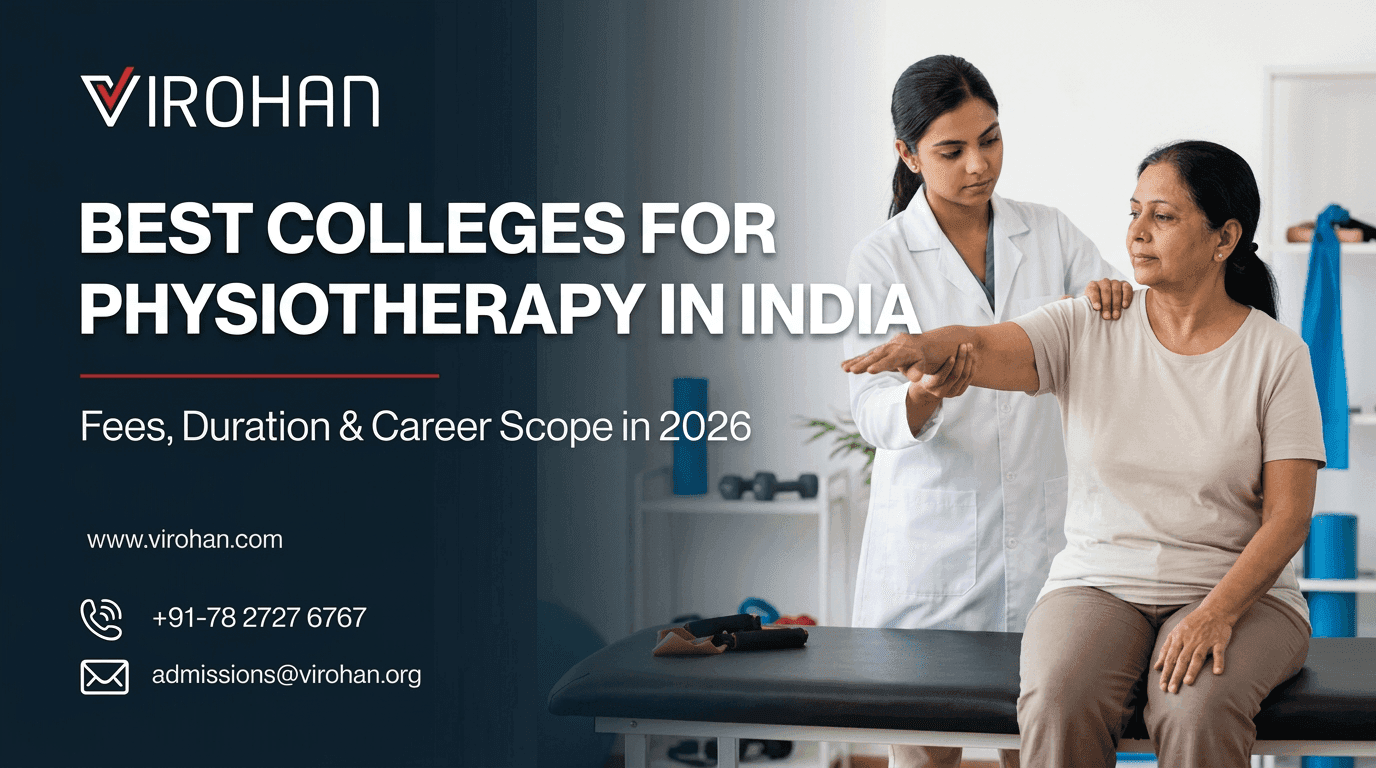
The best physiotherapy colleges in India for a Bachelor of Physiotherapy (BPT) combine a teaching hospital or strong clinical tie-ups, a full 1-year internship and a curriculum that follows the NCAHP framework. This list covers two government institutions and seven universities partnering with Virohan as their industry partner, such as Vikrant University, Gwalior and Lingaya's Vidyapeeth, Faridabad. For AY 2026-27, NEET is not required for BPT.
Hospitals are expanding rehabilitation wings, sports teams employ physiotherapists, and corporate wellness programs bring movement specialists into offices. A Bachelor of Physiotherapy (BPT) is the degree that opens this career. This guide covers what the profession involves, how the BPT program works, the specializations available, the careers you can build, and nine colleges where you can study BPT in 2026. If you are comparing fields, see these allied and healthcare courses after 12th and the highest paying allied and healthcare courses.
What is Physiotherapy?
Physiotherapy is a branch of healthcare focused on restoring, maintaining, and maximizing physical function and movement. It uses evidence-based physical interventions, including exercise prescription, manual therapy, and electrotherapy, to help patients recover from injury, manage chronic conditions, and prevent disability.
The scope of physiotherapy spans five major domains:
Musculoskeletal Rehabilitation deals with conditions affecting bones, joints, muscles, and connective tissue. This includes recovery after fractures, ligament tears, joint replacements, and the management of chronic conditions like arthritis and lower back pain.
Sports Physiotherapy focuses on the prevention, assessment, and treatment of injuries related to sport and physical activity. As professional leagues and sports academies grow in India, so does the need for physiotherapists who understand athletic biomechanics.
Neurological Rehabilitation addresses conditions affecting the brain, spinal cord, and nervous system. Patients recovering from stroke, traumatic brain injury and spinal cord injury, and those managing conditions like Parkinson's disease or multiple sclerosis, rely on neurological physiotherapy to regain independence in daily life.
Cardiopulmonary Rehabilitation supports patients with heart and lung conditions. After cardiac surgery, during recovery from respiratory illness, or for the long-term management of conditions like COPD and asthma, cardiopulmonary physiotherapy improves breathing capacity, exercise tolerance, and quality of life.
Paediatric and Community Rehabilitation works with children experiencing developmental delays, cerebral palsy, or congenital conditions, as well as community programs promoting physical activity, fall prevention in older adults, and workplace ergonomics.
Physiotherapists assess patients, identify movement disorders, and design and deliver treatment plans. That clinical responsibility is what makes physiotherapy a respected and rewarding first-choice healthcare career.
BPT Course: The Complete Picture
The Bachelor of Physiotherapy (BPT) is the undergraduate degree for a career as a physiotherapist in India. It is regulated under the National Commission for Allied and Healthcare Professions (NCAHP), which notified the Physiotherapy curriculum on 24 April 2025, with Corrigendum-1 dated 27 January 2026.
Duration
The BPT course runs for 5 years: 4 years of academic and clinical study followed by a compulsory 1-year internship in a hospital or clinical setting, where you work with patients under supervision.
Eligibility
For BPT at universities partnering with Virohan, you need:
- Qualification and marks: 12th pass with 40% in all subjects individually; English mandatory; minimum 50% in PCB
- Age: minimum 17 by the intake cut-off
- Entrance: NEET is not required for AY 2026-27. The NCAHP letter dated 02 March 2026 deferred the requirement to AY 2027-28, so check the position for the year you apply. Some universities run their own entrance test.
Government colleges set their own admission rules and counselling processes.
Curriculum
The BPT curriculum builds clinical competence across four academic years, moving from foundational sciences to specialized physiotherapy practice.
First Year establishes the scientific foundation: Human Anatomy, Physiology, Biochemistry, and Biomechanics, which teaches how forces act on the body during movement and how to analyse gait, posture, and joint mechanics.
Second Year introduces core physiotherapy modalities. Exercise Therapy covers strengthening, stretching, balance training, and functional movement. Electrotherapy teaches the use of ultrasound, TENS, interferential therapy, shortwave diathermy, and laser therapy for pain management and tissue healing. Pathology, Microbiology, and Pharmacology round out the year.
Third Year moves into clinical subjects: Orthopaedic Physiotherapy, Neurological Physiotherapy, General Medicine, General Surgery, and Community-Based Rehabilitation.
Fourth Year covers Cardiopulmonary Physiotherapy, Sports Physiotherapy, Research Methodology and Biostatistics, and Ethics and Professional Practice.
12-Month Internship is the final phase. You rotate through orthopaedics, neurology, cardiopulmonary, paediatrics, and general medicine departments, assessing patients, designing treatment plans, and delivering interventions under supervision.
Specialization Areas in Physiotherapy
After BPT, you can build a specialization through a 2-year MPT or focused clinical experience. The main areas are set out below, and the guide to BPT physiotherapy specializations covers each in depth.
Orthopaedic Physiotherapy
The most widely practiced specialization, covering musculoskeletal injuries and conditions: fractures, joint replacements, ligament reconstructions, spinal disc problems, and chronic pain conditions like frozen shoulder. Manual therapy techniques form a core part of practice.
Neurological Physiotherapy
Focuses on conditions affecting the brain, spinal cord, and nervous system. Stroke rehabilitation is the most common area of practice, alongside spinal cord injury rehabilitation, Parkinson's disease, multiple sclerosis, and traumatic brain injury recovery.
Sports Physiotherapy
Covers the prevention, diagnosis, and treatment of sports-related injuries, from acute management to post-surgical rehabilitation and biomechanical analysis.
Paediatric Physiotherapy
Works with infants, children, and adolescents with developmental delays, congenital conditions such as cerebral palsy, and childhood injuries. Treatment approaches are play-based and family-centered.
Cardiopulmonary Physiotherapy
Addresses heart and lung conditions. In ICU settings, cardiopulmonary physiotherapists help patients wean off ventilators and maintain muscle strength; in outpatient settings, they run cardiac and pulmonary rehabilitation programs.
Women's Health Physiotherapy
Addresses prenatal and postnatal exercise, pelvic floor rehabilitation, recovery after gynaecological surgery, and osteoporosis management, and is gaining traction in urban centers.
Career Paths After BPT
A BPT degree opens diverse career paths across healthcare and wellness. Roles include Physiotherapy Consultant, Rehabilitation Specialist, Orthopedic Physiotherapy, Ergonomics Specialist and Corporate Wellness Physiotherapy.
Hospital-Based Practice places you in physiotherapy departments, ICUs, orthopaedic wards, and neurology units of government and private hospitals, and builds broad clinical skills.
Sports Teams and Academies employ physiotherapists for injury prevention, acute management, and rehabilitation.
Rehabilitation Centres focus on helping patients recover from specific conditions over extended periods, such as stroke, spinal cord injury or post-surgical recovery.
Private Practice offers clinical independence. Many physiotherapists build experience in hospital settings before establishing their own clinics.
Corporate Wellness is a growing field, with companies hiring physiotherapists for ergonomic assessments, injury prevention workshops, and on-site treatment.
Community and Public Health roles in district hospitals, NGOs and government programs support disability prevention and rural healthcare delivery.
Teaching and Research open up with an MPT and clinical experience, including faculty positions and research roles in rehabilitation science.
Physiotherapy Salary in India
Physiotherapy earnings grow with experience, specialization, and the setting you work in.
| Role | Average salary | Top 10% earn above | Top 1% earn above | Source |
|---|
| Physiotherapist | ₹3.4 LPA | ₹5 LPA | ₹10.9 LPA | AmbitionBox, September 2026 |
| Senior Physiotherapist | ₹4.9 LPA | ₹7 LPA | ₹12.2 LPA | AmbitionBox, September 2026 |
An average of ₹3.4 LPA works out to about ₹28,000 a month. Senior physiotherapists and those who specialize in areas such as sports or neurological rehabilitation reach the upper bands, and private practice adds further earning potential with experience. Government hospital roles follow structured pay scales with long-term benefits. These figures are indicative rather than guaranteed.
Physiotherapy Course Fees
BPT fees are quoted as a total for the full 5-year program and vary by institution. Government colleges usually charge the least, while private universities charge more depending on infrastructure, location and hospital facilities.
Check the current total program fee for BPT at universities partnering with Virohan on virohan.com/courses, or talk to our expert counsellors. When you compare costs, include accommodation, books and travel for all five years. Education loans are widely available, and merit-based scholarships may be available; amounts, eligibility and availability can change, so check the current terms before you apply.
Where to Study: Top 9 Physiotherapy Colleges in India
Choosing where to study BPT means evaluating clinical exposure, faculty, hospital infrastructure, internship settings, and the overall learning environment. The list below covers two government institutions with large teaching hospitals and the seven universities partnering with Virohan as their industry partner that offer BPT.
1. Seth GS Medical College and KEM Hospital, Mumbai
Attached to KEM Hospital, one of Mumbai's largest public teaching hospitals, this government institution offers high clinical exposure across orthopaedic, neurological, and general medicine departments. Fees are low, and admission follows the Maharashtra state counselling process.
2. Pt. Deendayal Upadhyaya National Institute for Persons with Physical Disabilities (PDUNIPPD), Delhi
A central government institution under the Ministry of Social Justice and Empowerment, PDUNIPPD offers a BPT program oriented towards disability rehabilitation, with deep exposure to neurological and orthopaedic rehabilitation. Admission is through the institution's selection process, and fees are subsidized.
3. Vikrant University, Gwalior (with Virohan as industry partner)
Vikrant University in Madhya Pradesh offers BPT with Virohan as its industry partner, alongside the wider set of allied and healthcare degrees. You study for a UGC-approved degree awarded by the university, with access to Virohan's healthcare employer partners for internship and job opportunities.
4. Lingaya's Vidyapeeth, Faridabad (with Virohan as industry partner)
Lingaya's Vidyapeeth in Faridabad offers BPT, within reach of the Delhi NCR hospital network for clinical training. With Virohan as its industry partner, students get access to 2,000+ healthcare employer partners across 20+ cities for internship and job opportunities.
5. MIT University, Shillong (with Virohan as industry partner)
MIT University in Shillong offers BPT with Virohan as its industry partner, making physiotherapy training more accessible to students across the Northeast, with structured clinical exposure alongside the academic program.
6. SR University, Warangal (with Virohan as industry partner)
SR University in Telangana offers BPT with Virohan as its industry partner, giving students in South India a university route into physiotherapy with a full internship year.
7. Joy University, Kanyakumari (with Virohan as industry partner)
Joy University in Tamil Nadu offers BPT with Virohan as its industry partner, alongside B.Optom, B.MLS, B.MRIT and B.AOTT.
8. Invertis University, Bareilly (with Virohan as industry partner)
Invertis University in Uttar Pradesh offers BPT with Virohan as its industry partner, giving students in western Uttar Pradesh a nearby university option.
9. Shobhit University, Saharanpur (with Virohan as industry partner)
Shobhit University in Uttar Pradesh offers BPT with Virohan as its industry partner, alongside B.MRIT and B.AOTT.
Why Consider BPT at Universities Partnering with Virohan?
The universities teach and award the UGC-approved BPT degree, while Virohan works with them as industry partner. Virohan has nearly a decade in allied and healthcare education, and students get access to 2,000+ top healthcare brands for internship and job opportunities, along with essential communication, leadership, digital literacy, and English language skills. Seats are limited under current intake norms, so it helps to talk to our expert counsellors early.
How to Choose the Right Physiotherapy College
Clinical exposure matters most. The quality of your clinical training depends on the hospital environment you are placed in. Look for rotations in multi-specialty hospitals with high patient volumes, and ask whether you get hands-on practice during postings.
Teaching experience matters. Look for programs where teachers have worked in hospitals, sports settings, or rehabilitation centers.
Industry connections support your first job. Ask about internship settings, the types of organizations that hire graduates, and the career guidance available.
Location shapes your opportunities. Cities with large healthcare ecosystems offer more clinical training sites, while institutions in emerging healthcare cities can offer less competition for clinical placements.
Compare the total cost. Include total program fees for 5 years, accommodation, food, travel, books, and equipment.
Check recognition. Make sure the university is UGC-approved and that the BPT program follows the NCAHP framework.
Physiotherapy Course After 12th: Getting Started
If you are in Class 12 or have recently completed it with PCB, here is how to begin.
Step 1: Confirm your eligibility. You need 12th pass with 40% in all subjects individually, English mandatory and a minimum 50% in PCB, and you must be at least 17 by the intake cut-off.
Step 2: Check the entrance process. NEET is not required for BPT in AY 2026-27. Some universities run their own entrance test, and government colleges follow state counselling.
Step 3: Research institutions. Compare government colleges and universities partnering with Virohan on clinical exposure, internship settings and total program fees.
Step 4: Apply on time. Keep track of application deadlines, counselling dates, and document requirements.
Step 5: Compare offers carefully. Compare clinical exposure, total cost, internship settings and location, and talk to current students where you can.
Conclusion
Physiotherapy combines scientific knowledge with hands-on patient care, offers several specialization pathways, and lets you help people recover and live independently. The BPT is your entry point: a 5-year program that builds clinical competence from anatomy and biomechanics to specialized rehabilitation.
Where you study matters. Compare clinical exposure, internship settings and industry connections, whether you choose a government institution or a university partnering with Virohan. If you want help finding the right university, talk to our expert counsellors.